
Some law firms grow year after year while others plateau. The difference has less to do with legal expertise than you’d think.
The firms that win aren’t the ones with the best lawyers. They’re the ones that make it easiest for new clients to reach them.
Think about it: A potential client calls your office at 6:30 PM on a Tuesday. They’re stressed, they need help, and they’ve Googled three firms in your area. Your phone goes to voicemail. The next firm picks up.
Who do you think they hire?
Why Law Firms Need After-Hours Phone Coverage
In professional services, accessibility equals trust.
When someone calls your firm after hours, they’re not just checking if you’re available. They test whether you’ll be there when they need you. And if you’re not there at 6 PM on a Tuesday, they wonder: Will you be there during their trial? During their closing? When does their case get complicated?
First impressions happen on the first call. You don’t get a second chance.
The firms that understand this (the ones that grow market share while competitors stagnate) treat every inbound call as a competitive advantage. They know:
- 60-70% of new client calls happen outside traditional business hours. People call when they have time to think about their legal needs: evenings, weekends, lunch breaks.
- Most callers won’t leave a voicemail. They call the next firm on their list. If you’re not there to pick up, you’re not in the race.
- Response time matters more than you think. Studies show that firms that respond to inquiries within 5 minutes are 100 times more likely to connect with a lead than firms that wait an hour. By the next morning? You’ve lost them.
The best firms don’t compete on price. They don’t compete on billable hours. They compete on being the firm that’s there when it matters.

After Hours Calls for Lawyers: What They Tell You
Most managing partners miss this: After-hours calls aren’t an inconvenience. They’re a signal.
They’re high-intent leads.
Someone calls your estate plan practice at 8 PM on a Thursday. They aren’t casual browsers. They deal with something urgent: a family situation, a health scare, a life transition. They’re ready to hire. The question is whether they hire you or the firm that picked up.
They’re often higher-value clients.
Busy professionals (executives, business owners, doctors) don’t have time to call during your 9-5 hours. They call when they can, which is after work. These are the clients most firms want to attract. And they’re the ones most firms miss.
They’re willing to pay for responsiveness.
Clients who need legal help fast aren’t shopping for the cheapest option. They look for competence and reliability. When you answer the phone, and others don’t, you demonstrate both in the fastest way possible.
How Top Law Firms Handle Evening and Weekend Calls
Top firms don’t tell their attorneys to answer calls at 9 PM. That’s not sustainable, and it’s not necessary.
Instead, they use professional phone coverage that combines live receptionists with smart call management. In practice, it works like this:
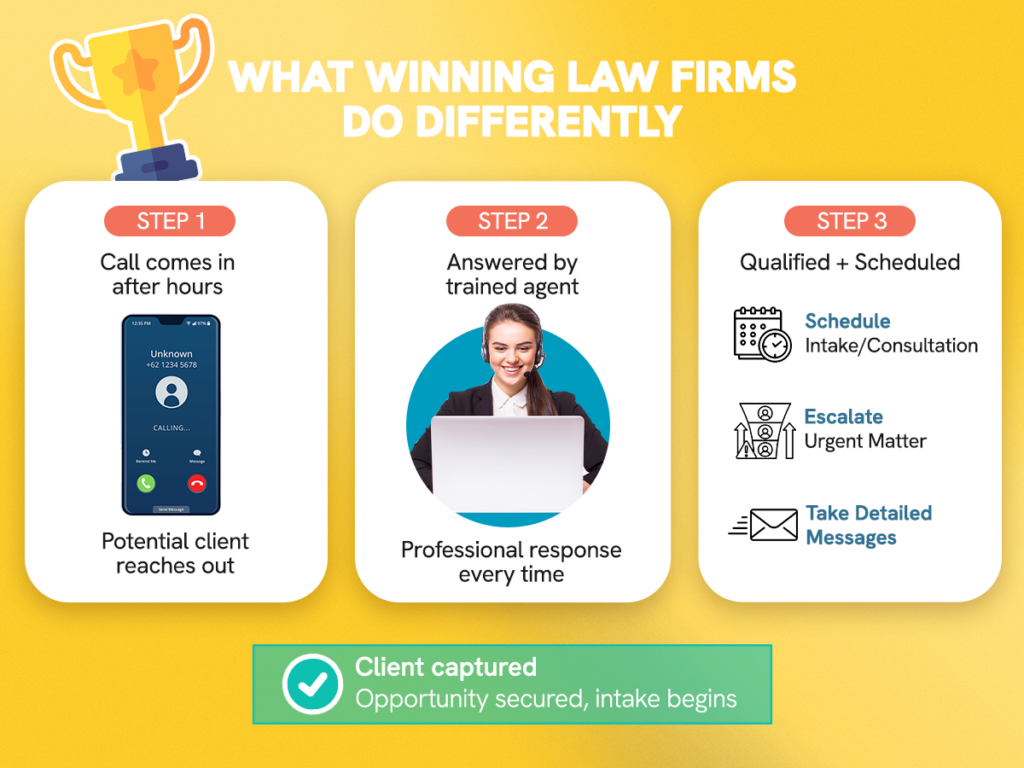
New client inquiry at 7 PM:
A trained receptionist who knows your firm, understands your practice areas, and can have an intelligent conversation about what kind of legal help the caller needs answers the call. They collect key information (name, contact details, nature of the issue, urgency level) and either:
- Schedule a consultation for the next available time slot (if the caller is ready to commit)
- Send a detailed message summary to the intake coordinator (if the caller needs to think about it)
- Escalate to the on-call attorney right away (if it’s a genuine emergency like an arrest or a restraining order)
Existing client with an urgent question at 6:30 PM:
The system recognizes them as an existing client (not a cold lead) and routes them to the attorney on their case. If that attorney isn’t available, the call goes to the appropriate backup. The client never feels abandoned.
Routine inquiry at 8 AM on Saturday:
“Do you handle car accident cases?” “What’s your consultation fee?” These get answered right away by a professional who can speak with knowledge about your firm, without pulling an attorney away from their weekend.
The key: Human judgment for complex situations. Smart systems for routine tasks. Never one without the other.
Firms that use only automated systems risk frustration with robotic interactions. Firms that rely only on humans can’t scale well or cover 24/7 without burnout.
The firms that win new business? They’ve figured out the blend.
According to the American Bar Association’s 2024 Legal Technology Survey, firms with 24/7 client accessibility reported 35% higher client satisfaction scores than firms with traditional business-hours-only availability.
What It Looks Like When You Get This Right
Story from a mid-sized estate plan firm:
They used to lose 15-20 calls per month to voicemail, most after 5 PM and on weekends. Their close rate on inbound calls was around 35%.
After they set up professional after-hours coverage, they saw:
- 90% of after-hours calls captured (vs. 0% to voicemail)
- Close rate jumped to 48% (because they reached people while they were still engaged)
- 12 additional new clients per quarter (at an average value of $4,500 each)
- $54,000 in additional revenue per quarter (vs. $1,800/month cost for coverage)
The ROI wasn’t subtle. And it compounded: those new clients referred others, came back for additional services, left positive reviews.
But the managing partner said this was most valuable:
“Our existing clients stopped feeling like they couldn’t reach us. That alone was worth it. We weren’t just capturing new business. We protected the relationships we’d built.”
The Firms That Don’t Do This
They’re not bad firms. They’re not incompetent. They just leave opportunity on the table.
They tell themselves:
- “Our clients know to call during business hours.”
- “If it’s urgent, they’ll leave a voicemail.”
- “We can’t afford to staff the phones 24/7.”
Meanwhile, their competitors:
- Capture the leads they miss
- Build a reputation for being “the firm that’s there”
- Grow while they plateau
In a competitive market, accessibility is a form of differentiation. When legal services are commoditized (everyone says they’re experienced, competent, client-focused), being the firm that answers the phone becomes a real advantage.
What to Do This Week
If you’re serious about growth (or even just want to protect the pipeline you have), evaluate this:
1. Track your missed calls for one week.
Most phone systems can show you this. How many calls went to voicemail? What time did they come in? How many people left messages vs. hung up?
2. Calculate the cost.
If your average new client is worth $3,000-$5,000, and you miss 10-15 calls per month, that’s $30,000-$75,000 in lost annual revenue. Even if only 30% of those calls would have converted, you still look at $10,000-$20,000 that walked away.
3. Ask yourself: Can we afford NOT to fix this?
Professional phone coverage during after-hours and overflow periods costs $500-$1,500/month based on call volume. That’s the price of one mid-value client. If you capture even two additional clients per quarter, it pays for itself several times over.
Learn more about how we work for professional service firms.
The Bottom Line
The firms that never miss a call don’t work harder. They work smarter.
They recognize that accessibility isn’t optional. It’s table stakes. And they build systems that let them be responsive without burnout or compromise to the quality of their legal work.
If you still send new client calls to voicemail at 6 PM, you’re not just missing calls. You miss opportunities to grow.
Want to see how top firms handle after-hours coverage? Book a demo or call our demo line to hear it in action: [Demo Line Number]