
Tax season brings a surge of calls that can make or break your year. For accounting firms, it’s the Super Bowl. For law offices that handle estate plans or business formations tied to tax deadlines, it’s just as critical. And for any service business (HVAC companies, restaurants, consultants), spring often means peak demand.
But most business owners don’t realize this: The calls you miss during busy season cost you more than the calls you answer.
Much more.
Tax Season Missed Calls: What Each One Costs Your Practice
Let’s break down what a single missed call costs.
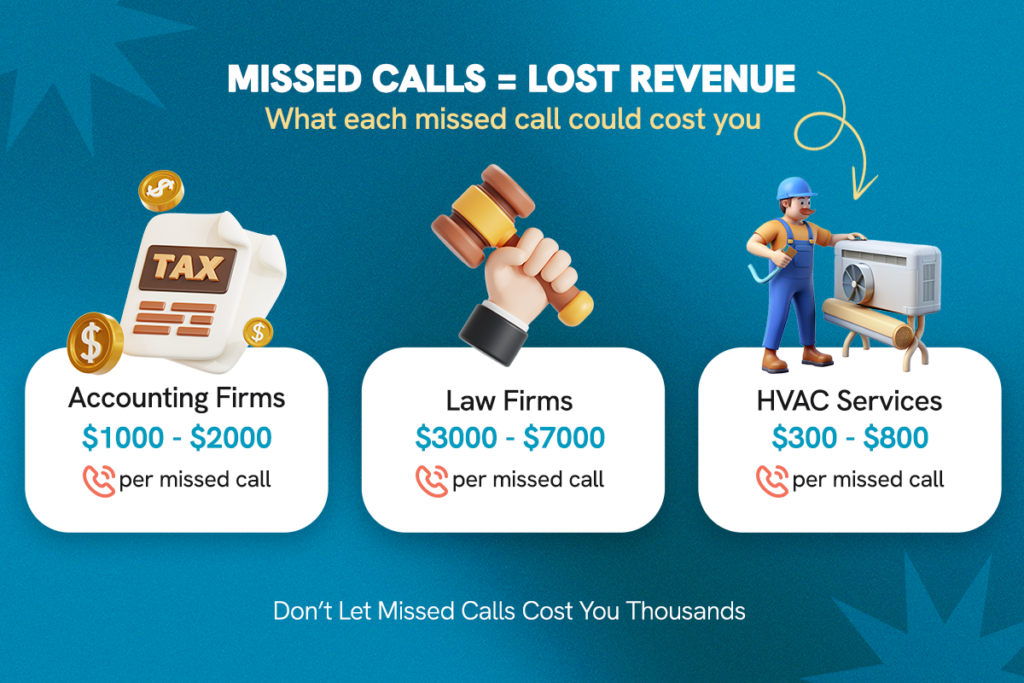
For an accounting firm: A new client is worth $2,500-$5,000 in annual revenue (tax prep, quarterly filings, bookkeeping services). If your close rate on inbound calls is 40%, every missed call represents a potential $1,000-$2,000 in lost revenue.
For a law firm: A new estate plan client might be worth $3,000-$7,000. A business formation client? $5,000-$15,000. Miss three calls during your busiest week in March, and you could leave $15,000-$45,000 on the table.
For home service companies: Emergency HVAC repair calls during the first warm week of spring convert at 60-70%. Average ticket: $300-$800. Miss just five calls and you lose $2,000-$4,000 in revenue. Those customers will remember you didn’t pick up when they needed you.
Now multiply that across a full tax season. If your office misses just 2-3 calls per week from February through April, you could face thousands in lost annual revenue, based on your average client value.
And that’s just direct revenue. It doesn’t account for:
- Referrals those clients would have sent
- Repeat business over 3-5 years
- The lifetime value of a relationship that never started
Why Your Front Desk Misses Calls (Even When Everyone Tries Hard)
It’s not because your team doesn’t try. It’s because there aren’t enough hours in the day.
Office managers tell us this every March:
“Our receptionist drowns in work.”
She answers calls, checks people in, manages the calendar, and handles walk-ins. All at once. Something has to give. The phone gives first.
“We can’t answer during lunch.”
Your team deserves breaks. But calls don’t stop between 12-1 PM. They don’t stop at 5:01 PM when everyone logs off.
“After-hours calls go straight to voicemail.”
Most people don’t leave messages anymore. They call the next firm on their list. The one that picked up.
“Everyone sits in client meetings.”
During tax season, your CPAs run back-to-back appointments. During trial prep, your attorneys sit in depositions. Your team does what they should do. But the phone keeps ringing.
This isn’t a staffing problem. It’s a capacity problem during a predictable surge.
Phone Answering Service Cost vs. Lost Revenue: The Math
The solution isn’t to hire a temp receptionist for six weeks (expensive, requires training, disrupts your workflow). And it’s not to let calls go unanswered (too costly, as we established).
Modern phone coverage blends professional receptionists with smart call management. You get the best of both worlds.
How it works:
Routine questions get handled fast.
“What are your hours?” “Where are you located?” “Do you handle tax extensions?” These don’t need to interrupt your team. A trained answering service can respond with accuracy and professionalism.
Urgent matters get escalated right away.
A potential client calls about an IRS audit? An existing client has a tax emergency? Those calls get routed to the right person with context, so your team knows what they walk into.
After-hours calls get captured, not lost.
Someone calls at 7 PM on a Tuesday. They don’t hit voicemail. They speak with a professional who can take detailed information, answer basic questions, and schedule a callback for first thing the next morning.
Your team stays focused on what they do best.
Your CPAs prepare returns. Your attorneys draft documents. Your HVAC techs fix furnaces. They don’t get pulled into phone tag or spend 20 minutes answering “Do you do business taxes?”
The technology component (smart call routing, automated schedule confirmations, message summaries) handles the logistics. The human component handles the judgment calls, the empathy, the complex questions.
You don’t have to choose between efficiency and personal service. The best systems give you both.
According to a Harvard Business Review study on customer service response times, firms that respond to inquiries within 5 minutes are 100 times more likely to connect with a lead than firms that wait an hour. By the next morning? You’ve lost them.
Business Phone Coverage ROI: Simple Numbers
Let’s use conservative numbers.
Cost of professional phone coverage during peak season:
$500-$1,500/month for 8-12 weeks (February-April) = $1,500-$4,500 total
Value of just 3-5 additional clients you capture:
3 clients × $3,000 average value = $9,000
5 clients × $3,000 average value = $15,000
Even if you capture one or two clients you would have lost otherwise, the service pays for itself. Everything beyond that is pure upside.
And remember: those clients will refer others. They’ll come back next year. They’ll leave positive reviews. The lifetime value compounds.
What to Do Before Next Tax Season Starts
If you read this in March 2026 and think “I wish I’d set this up in January,” you’re not alone. Most firms don’t think about phone coverage until they’re underwater.
But you can still salvage the rest of this season and set yourself up for success next year.
For the rest of March and April:
Even if you add coverage for afternoons and after-hours, you make a significant difference. You won’t capture every missed call, but you’ll capture the ones that matter most (late-day inquiries, weekend emergencies, overflow when your receptionist gets slammed).
For 2027 tax season:
Start to plan in December 2026. Get coverage in place by mid-January. Train the answering service on your most common questions, your schedule preferences, your escalation protocols. By the time February hits, they’re an extension of your team, not a last-minute patch.
Year-round:
If after-hours calls and lunch-hour gaps cost you leads during slow months too, consider baseline coverage all year. The cost is minimal compared to the revenue protection.
Learn more about how professional answering services work for different industries and call volumes.
The Bottom Line
You didn’t build your practice to lose clients because your phone went unanswered.
But during your busiest season (the time when you generate the most revenue and attract the most new business), that’s what happens if you don’t have a plan for overflow.
Professional phone coverage isn’t an expense. It’s revenue protection.
The question isn’t whether you can afford it. The question is whether you can afford to keep missing calls.
Want to see how modern phone answering works? Book a quick demo or call our demo line to hear it in action: (914) 758-4595